
How to Size an Industrial Drying Oven
A practical engineering guide for preliminary industrial drying oven sizing—covering usable chamber size, product loading, heat load, moisture removal, exhaust, heating capacity, airflow, residence time, conveyor length, and the project data required before final equipment design.
- Chamber size starts with the loaded product envelope—not the product dimensions alone. Racks, carts, airflow clearance, door access, and maintenance space matter.
- Heating power is driven by the complete heat load. Product heating, water evaporation, incoming make-up air, exhaust, chamber losses, and recovery time must be considered together.
- Moisture removal often controls drying capacity more than oven temperature. High-water loads can require more exhaust and heater capacity than expected.
- This guide is for preliminary sizing. Final power, airflow, ducting, fan selection, safety factors, controls, and acceptance criteria still require project engineering.
What “Sizing an Industrial Drying Oven” Actually Means
Oven sizing is not one calculation. A usable industrial drying oven concept must answer several connected questions: how large the chamber or heated path must be, how much heat the process requires, how much moisture or vapor must be removed, how much circulation and exhaust air are needed, and whether the available cycle time or line speed is realistic.
Physical Size
Usable chamber dimensions, rack or cart arrangement, conveyor width, product pitch, door geometry, and service access.
Thermal Capacity
Product heat load, water evaporation, make-up air, exhaust, wall losses, heat-up time, and recovery after loading.
Process Capacity
Batch output, hourly throughput, drying time, residence time, line speed, final moisture, and acceptance criteria.
Size the Usable Chamber Around the Loaded Product Envelope
Start with the complete loaded condition: product + rack + tray + cart + fixture + handling clearance. Then add enough space for airflow distribution, door opening, loading tolerance, sensors, and maintenance access.
- Use the largest loaded envelope—not the nominal product dimensions
- Check shelf spacing, cart frame, tray edges, product overhang, and door clearance
- Leave enough free area for supply and return air to reach the product
- For heavy loads, include rail, floor, or cart geometry early
- For conveyor systems, include product pitch, carrier width, transfer points, and return path
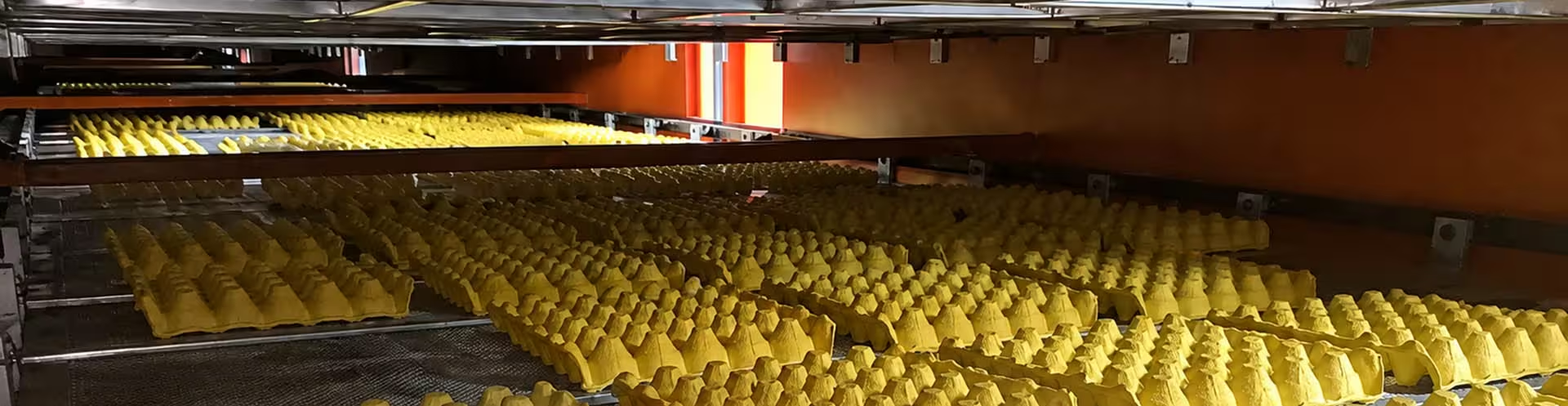
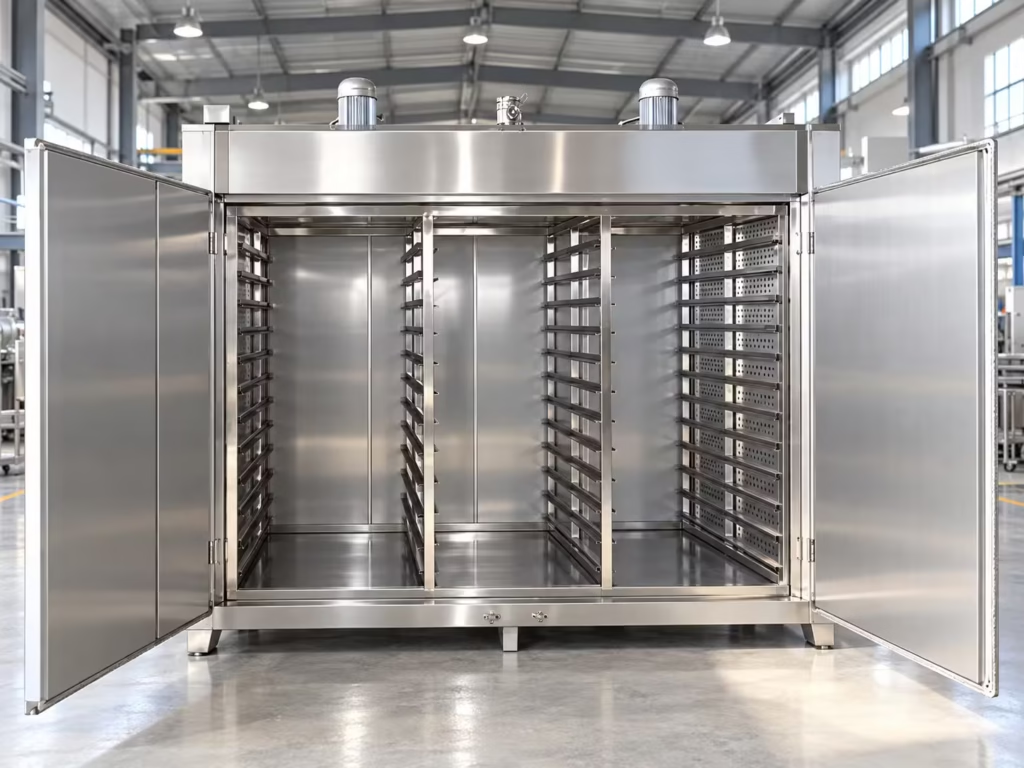
For oversized batch loads, the Industrial Walk-In Oven may be a practical chamber format. For continuous handling, compare the Industrial Conveyor Belt Dryer.
Calculate the Energy Required to Heat the Product
The first thermal load is the sensible heat required to raise the product, rack, tray, cart, or fixture from its starting temperature to the required process temperature.
Example
A 500 kg steel load enters at 25°C and must reach 120°C. Using an approximate steel heat capacity of 0.50 kJ/kg·K:
If that heat were supplied uniformly over 45 minutes with no other losses, the average product-heating power would be about 8.8 kW. Real oven power must be higher because the oven also heats racks, air, insulation surfaces, and moisture while continuously losing heat.
Calculate the Heat Required to Evaporate Water or Process Moisture
Drying is not only product heating. Energy is also consumed to heat and evaporate the water or volatile material leaving the product. For high-moisture loads, this term can become one of the largest parts of the thermal calculation.
Example
If a batch must remove 20 kg of water:
Spread over 60 minutes, that is roughly 12.5 kW of average latent heat load before adding product heating, air heating, wall losses, and safety margin.
In real drying calculations, the water may start below boiling temperature and evaporation may occur below 100°C. The process model should therefore account for the actual material temperature, vapor partial pressure, airflow, and drying mechanism.
Add the Heat Needed for Air Exchange, Oven Surfaces, Openings, and Recovery
Theoretical product and evaporation loads are only part of the installed power requirement. A practical oven must also replace the energy leaving through walls, doors, exhaust air, leakage, product openings, conveyor openings, and hot-air discharge.
Exhaust / Make-Up Air
Fresh incoming air must be heated from ambient temperature to the oven operating temperature.
Wall & Door Losses
Heat escapes through insulated panels, doors, floor, penetrations, frames, and thermal bridges.
Loading / Door Recovery
Batch ovens lose heat when doors open and when cold products, racks, or carts enter the chamber.
Continuous Openings
Conveyor inlet and outlet openings can create continuous hot-air loss and cold-air infiltration.
Estimate Installed Heating Power from the Required Heat-Up or Drying Time
Once the major heat loads are estimated, convert the required energy into power over the available heat-up or cycle time. Then add appropriate allowance for losses, control margin, and operating variability.
Installed heater power is normally higher than the calculated average process load because the oven must recover from cold starts, door openings, production variability, ambient changes, and control cycling.
Size Circulation and Exhaust from the Product and Moisture Load
Circulation airflow and exhaust airflow solve different problems. Internal circulation distributes heat through the load. Exhaust removes moisture or vapor and introduces fresh air that must then be reheated.
Circulation Airflow
Selected to move heat through the product, reduce temperature gradients, and reach all loaded surfaces.
Exhaust Airflow
Selected from moisture or vapor release, process requirements, and—where relevant—safety calculations.
Make-Up Air
Balances exhausted air and affects chamber pressure, heat load, temperature recovery, and process stability.
Airflow should be checked against rack spacing, product orientation, blocked surfaces, conveyor support, and chamber geometry. More fan capacity does not automatically produce better drying if the air short-circuits around the load.
Size Conveyor Heated Length from Required Residence Time and Line Speed
For a continuous drying oven, chamber length is driven by the time the product must remain inside the effective heated process zone. Conveyor speed, product pitch, throughput, and required drying time therefore connect directly to oven length.
Example
If the product requires 30 minutes of effective drying time and the conveyor travels at 0.20 m/min:
This is the effective heated travel length only. Entry/exit transitions, unheated transfers, cooling zones, turning sections, and maintenance access can increase the overall machine length.
When linear plant space is limited, a U-Shaped Drying Oven can return the conveyor path and preserve residence time without requiring the same straight-line footprint.
Preliminary Batch Drying Oven Sizing Example
The following simplified example shows how the major sizing terms connect. It is not a final equipment calculation.
| Input | Example Value | Why It Matters |
|---|---|---|
| Product load | 500 kg steel | Controls sensible product heat load |
| Incoming temperature | 25°C | Defines temperature rise |
| Target temperature | 120°C | Defines process setpoint and ΔT |
| Water removed | 20 kg per batch | Controls latent evaporation load |
| Heat-up / drying period | 60 minutes | Converts required energy into average power |
| Loading method | 2 carts | Affects chamber dimensions and airflow paths |
That 19.1 kW does not represent the final heater size. It excludes cart heating, chamber warm-up, exhaust/make-up-air load, wall losses, door recovery, process variability, and design margin. A final equipment calculation must add those loads before installed power is selected.
Why Real Projects Change the Preliminary Calculation
The equations are useful, but industrial drying projects rarely behave like ideal textbook systems. Final sizing should account for the details that change heat transfer, evaporation rate, and effective process time.
Dense Loading
A tightly packed rack can reduce local air velocity and slow internal moisture removal even when total heater power is adequate.
Product Thermal Lag
Thick or high-mass parts may require much longer to reach useful drying temperature than the chamber air.
Door / Conveyor Openings
Large openings increase infiltration and can destabilize temperature unless airflow and heater capacity compensate.
Variable Ambient Conditions
Winter intake air, humid incoming air, or seasonal plant conditions can materially change the real operating load.
Turn the Preliminary Sizing into a Quote-Ready Drying Oven Specification
A useful RFQ should connect physical size, process load, heating, airflow, exhaust, loading, controls, utilities, and acceptance requirements. That allows the manufacturer to design the oven as one system instead of quoting chamber dimensions first and correcting the process later.
Confirm the Equipment Direction
Use the Industrial Drying Oven Selection Guide if the oven type is not yet fixed.
Prepare the RFQ
Use the Industrial Drying Oven RFQ Checklist to collect the information needed for quotation and engineering review.
Review the Core Product Family
See Industrial Drying Ovens for ZonHoo batch, hot-air, high-temperature, infrared, conveyor, and custom drying equipment directions.
Final oven dimensions, heating power, circulation fans, exhaust, ducting, controls, interlocks, temperature-uniformity targets, and acceptance documents should be confirmed from the actual project data.
Industrial Drying Oven Sizing FAQ
How do I calculate the required size of an industrial drying oven?
How do I estimate industrial drying oven heating power?
Why can a high-moisture drying process require much more heater power?
How do I calculate conveyor dryer length?
How much exhaust does an industrial drying oven need?
Should heater power be selected with a fixed safety factor?
What information should I send ZonHoo for final drying oven sizing?