
Industrial Drying Oven Cost Guide
What determines the cost of a custom industrial drying oven? This guide explains how chamber size, temperature, heating method, moisture load, airflow, exhaust, loading hardware, conveyor architecture, safety systems, controls, documentation, shipping, and installation affect the final project price.
- There is no meaningful “standard price” for a custom industrial drying oven. The chamber, load, moisture removal, airflow, exhaust, heating, controls, and handling system change the equipment architecture.
- Chamber size is only one cost driver. A smaller solvent-safe oven or high-exhaust dryer can cost more than a larger basic batch chamber.
- Compare quotations by scope, not only by total price. Heating power, circulation fans, exhaust, insulation, controls, loading hardware, FAT, documentation, shipping scope, and installation scope must be aligned.
- The lowest purchase price can create the highest project cost if the oven is under-sized. Slow heat-up, poor drying uniformity, insufficient exhaust, or weak loading design can reduce production output after installation.
Why There Is No Single Standard Industrial Drying Oven Price
Industrial drying ovens are often purchased by internal chamber dimensions, temperature, and heating source. Those details are important, but they do not define the complete machine. A 2 × 2 × 2 m chamber drying lightly loaded metal parts is not the same project as the same chamber removing a large quantity of water, handling solvent-bearing coatings, or carrying several tons on a rail cart.
Same Size, Different Heat Load
Product mass, moisture removal, cycle time, and exhaust can change required heating power dramatically.
Same Temperature, Different Air System
Dense racks, large products, conveyor openings, or moisture-heavy loads may require very different fan and ducting systems.
Same Oven, Different Project Scope
PLC, recording, FAT, explosion protection, transport modules, installation, commissioning, and certification can materially change cost.
The Main Factors That Change Industrial Drying Oven Cost
The relative impact varies by project. The table below is useful for quote planning, not as a fixed pricing formula.
| Cost Driver | Typical Cost Impact | Why It Changes the Equipment |
|---|---|---|
| Chamber / process size | High | More panel area, structure, insulation, doors, floor, ducting, airflow volume, and shipping volume |
| Operating temperature | Medium–High | Insulation thickness, internal materials, seals, components, fan selection, and heater design may change |
| Product / batch weight | Medium–High | Heating power, floor strength, carts, rails, frames, and loading hardware |
| Moisture / vapor load | High | Exhaust, make-up air, heater power, ducting, process time, and possible safety requirements |
| Airflow / uniformity requirement | Medium–High | Fan quantity, fan power, ducting, baffles, plenums, sensors, and FAT/mapping scope |
| Conveyor / loading system | High | Belt, chain, overhead conveyor, carts, rails, drive system, VFD, turn sections, fixtures, and integration |
| Explosion protection / hazardous vapor | High | Ventilation, interlocks, component selection, controls, compliance scope, and documentation |
| Controls / data logging | Medium | PLC, HMI, recorder, sensors, recipes, network communication, software, alarms, and traceability |
| FAT / documentation / certification | Low–High | Depends on mapping, reports, certificates, third-party requirements, and customer standards |
| Shipping / installation | Project-Specific | Machine dimensions, modularization, container type, freight route, site access, and installation scope |
Chamber Size and Loading Method Usually Change Cost Together
Increasing chamber dimensions adds more than sheet metal. Larger ovens often require stronger frames, more insulation, larger doors, higher circulation volume, more heater capacity, more floor reinforcement, and different shipping arrangements.
Shelf / Rack Loading
Usually structurally simpler, but dense multi-tier loading may require more careful airflow distribution.
Cart / Trolley Loading
Adds cart frames, wheels, floor or guide design, and door clearances, but improves batch handling flexibility.
Rail / Truck-In Loading
Heavy-load rails, floor structure, external transfer, door sealing, and cart design can materially change the project scope.
Continuous Conveyor
Adds conveyor structure, drive system, speed control, transfers, product support, line interlocks, and maintenance access.
Higher Temperature Is Not the Only Reason Heating Cost Changes
Installed heating power is driven by the complete thermal load: product mass, temperature rise, moisture evaporation, exhaust / make-up air, chamber losses, door openings, conveyor openings, and required heat-up or recovery time.
Electric Heating
Usually straightforward to control and integrate, but high installed kW can affect cabinet size, wiring, breakers, and site electrical capacity.
Gas Heating
May suit larger thermal loads or local fuel economics, but burner, combustion, gas train, exhaust, and site requirements add system complexity.
Infrared / Hybrid Heating
Can add emitter zones and specialized controls but may reduce process length or improve surface heating for suitable applications.
Related equipment directions include Hot Air Circulation Dryers, High Temperature Drying Ovens, and Far-Infrared Drying Ovens.
High Moisture Removal Can Raise Cost Even When the Chamber Is Small
A compact oven removing a large quantity of water or solvent may need high exhaust flow, large make-up-air capacity, stronger circulation, more heating power, larger ducts, additional fans, and more complex controls.
- More moisture removal can increase exhaust requirement
- More exhaust means more incoming air must be reheated
- Dense loads may require stronger fans and more engineered ducting
- Tighter temperature uniformity can require additional sensors, airflow balancing, and FAT work
Batch and Continuous Ovens Spend Money in Different Places
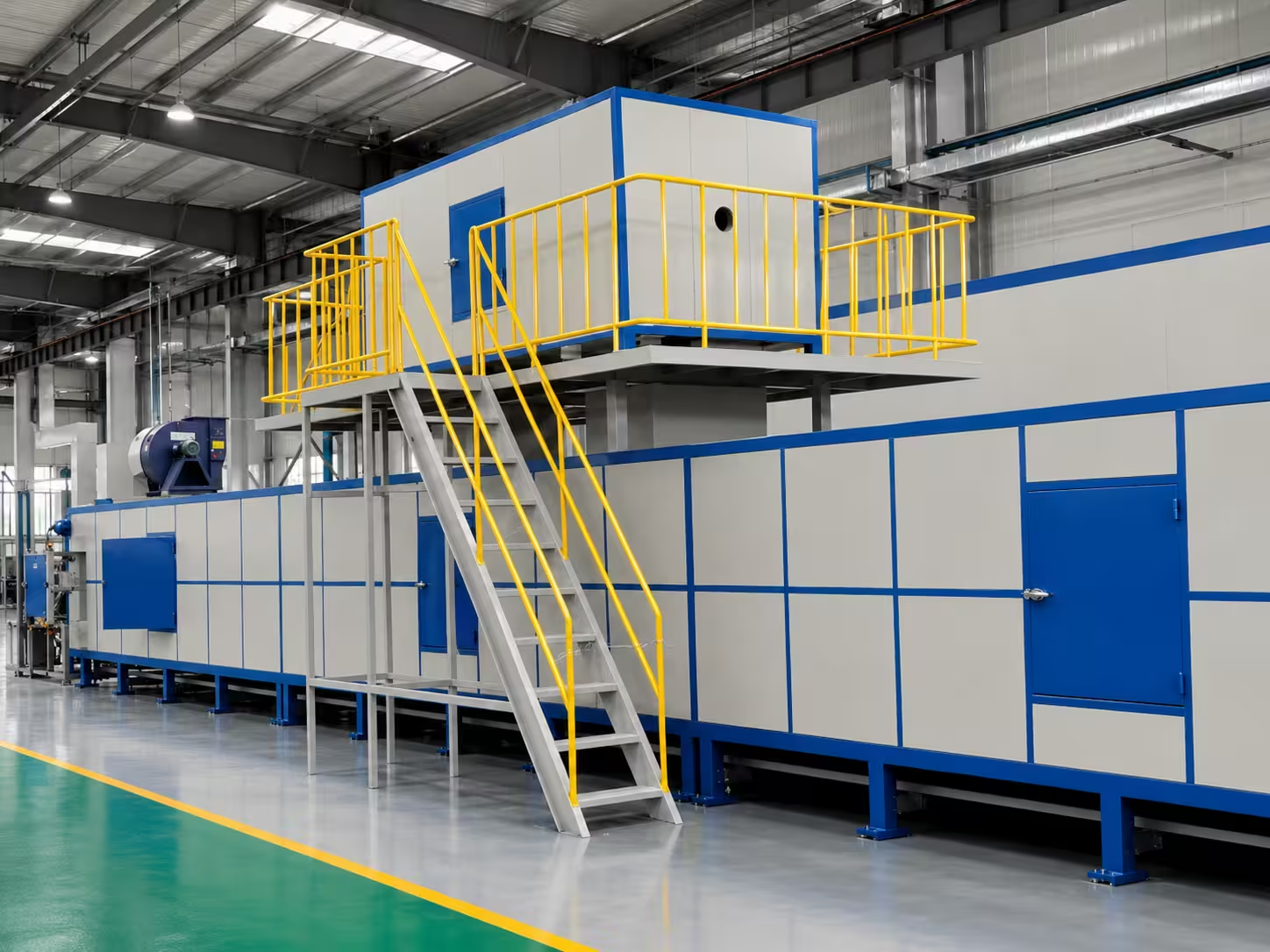
A batch oven concentrates cost in the chamber, doors, heating, circulation, loading hardware, and controls. A continuous dryer adds conveyor hardware, drives, line-speed control, transfer sections, multiple zones, and line integration.
| Cost Area | Batch Drying Oven | Continuous Drying Oven |
|---|---|---|
| Chamber / enclosure | Usually concentrated in one insulated chamber | Distributed across heated line length and zones |
| Product handling | Racks, carts, rails, forklifts, manual loading | Belt, chain, overhead conveyor, fixtures, transfers |
| Controls | Recipes, timers, alarms, fans, heaters, doors | Zone controls, VFD speed, line interlocks, synchronization |
| Installation | Often simpler if shipped as one chamber or modules | More alignment, conveyor integration, and line commissioning |
| Operating economics | Strongly affected by batch utilization and idle time | Strongly affected by line utilization and continuous loading |
Project Requirements Beyond Heating Can Materially Change the Quote
Explosion Protection
Solvent-bearing processes can require engineered exhaust, safety interlocks, classified components, monitoring, and project-specific compliance scope.
PLC / HMI / Data Logging
Recipes, multiple sensors, recorders, alarms, remote communication, and customer protocols add hardware and software scope.
Uniformity Mapping / FAT
Defined acceptance tests require sensors, test time, reports, mapping procedures, and documentation.
Certification / Third-Party Scope
Required standards, component approvals, inspections, or third-party certification must be identified before final quotation.
Related guidance: Explosion-Proof Drying Oven and Industrial Drying Oven Temperature Uniformity & FAT.
Factory Price Is Not the Same as Total Delivered Project Cost
Large industrial ovens can be affected by container dimensions, frame-box or open-top requirements, modularization, port handling, inland transport, crane access, site assembly, utilities, ducting, foundations, and commissioning.
Shipping Configuration
One-piece equipment can simplify assembly but increase freight complexity. Modular equipment can reduce transport constraints but adds site assembly work.
Site Preparation
Power, gas, exhaust ducts, foundations, rails, drainage, floor level, ventilation, and installation clearance may sit outside the oven supplier’s factory scope.
Installation / Commissioning
Large systems may require mechanical assembly, electrical connection, burner setup, conveyor alignment, testing, and operator training.
How to Compare Industrial Drying Oven Quotations Correctly
Put each quotation into the same scope table before deciding which price is lower. Otherwise, one supplier may include items that another supplier has omitted.
| Compare This Item | What to Check | Why It Matters |
|---|---|---|
| Usable chamber dimensions | True working space after ducts / plenums / rails | Nominal external size can be misleading |
| Heating power / method | Installed kW, burner duty, heat-up basis | Under-powered ovens may miss cycle-time targets |
| Circulation fans | Quantity, power, arrangement, operating temperature | Airflow quality affects drying and uniformity |
| Exhaust / make-up air | Fan, duct connection, control method, calculated basis | Critical for moisture / vapor removal |
| Loading system | Racks, carts, rails, conveyors, fixtures, transfer equipment | Can be a major project cost |
| Controls | PID/PLC/HMI, sensors, recipes, recorder, remote functions | Controls scope varies widely |
| Safety | Interlocks, over-temperature, explosion-protection scope, alarms | Must match the actual process risk |
| FAT / documentation | Drawings, manuals, mapping, reports, certificates | Can affect acceptance and qualification |
| Freight / installation | Incoterm, packing, container type, site installation, commissioning | Changes total delivered project cost |
Compare like-for-like technical scope first. Then compare price. A quotation is only “cheaper” when the performance, loading system, controls, safety, documentation, delivery scope, and acceptance criteria are genuinely comparable.
How to Reduce Project Cost Without Under-Sizing the Drying Oven
The best cost reduction usually comes from simplifying requirements that do not improve the process—not from removing the capacity the process actually needs.
- Use the smallest chamber that still provides correct loading and airflow clearance
- Do not specify a higher maximum temperature than the process needs
- Choose batch instead of continuous when throughput does not justify conveyor complexity
- Use standard electrical components where customer specifications allow
- Define the real FAT / documentation requirement instead of copying unrelated project specifications
- Design around standard shipping dimensions where practical for large equipment
- Provide accurate product and moisture-load data early to avoid over-sizing heater, fan, and exhaust systems
Get a Useful Price by Sending a Quote-Ready Drying Oven Requirement
The fastest way to receive a meaningful quotation is to define the product, load, temperature, drying time, moisture or vapor condition, loading method, utilities, floor space, controls, and acceptance requirements together.
Still Choosing the Oven Type?
Need Preliminary Sizing?
Ready to Request Pricing?
Use the Industrial Drying Oven RFQ Checklist.
Industrial Drying Oven Cost FAQ
How much does an industrial drying oven cost?
What is the biggest factor affecting industrial drying oven price?
Is a continuous drying oven more expensive than a batch oven?
Does higher drying temperature always mean a much higher oven price?
Why does high exhaust airflow increase drying oven cost?
How should I compare quotations from different industrial oven suppliers?
What information should I send to get an accurate drying oven quotation?