

Continuous Sterilizing Oven
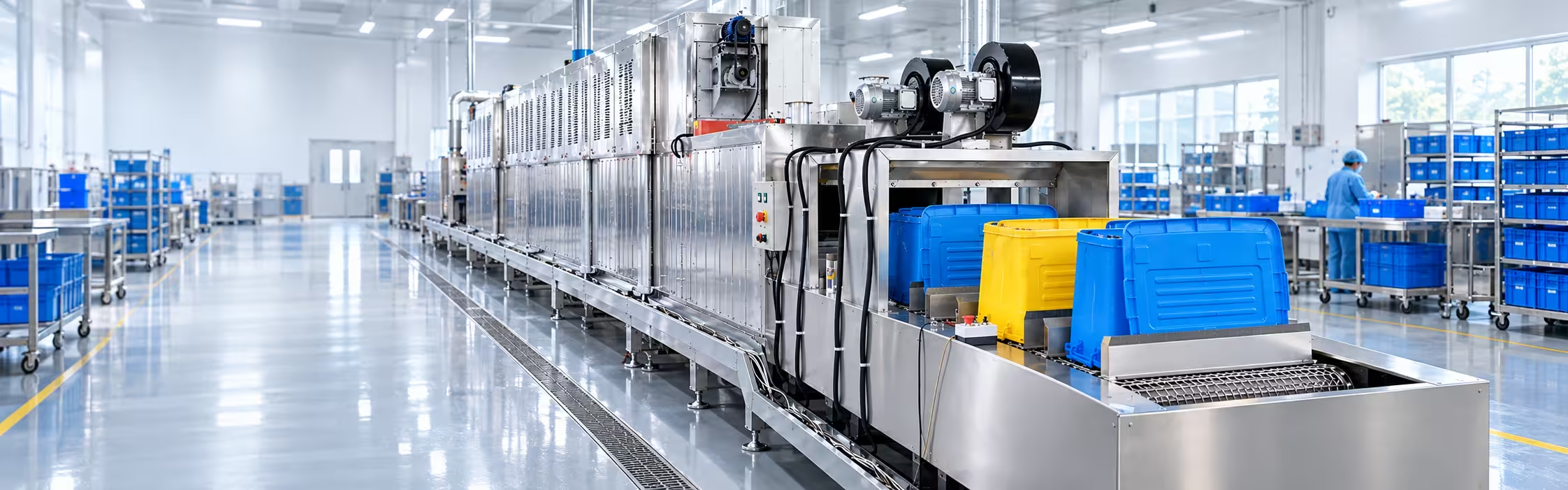
ZonHoo continuous sterilizing ovens are engineered for production processes that require repeatable thermal exposure while products move continuously through a heated chamber. Conveyor speed, residence time, temperature zones, airflow and line controls are coordinated around the customer’s defined sterilization process requirements.
Watch a ZonHoo continuous sterilizing oven with controlled conveyor movement, repeatable residence time and coordinated thermal processing.
What Is a Continuous Sterilizing Oven?
A continuous sterilizing oven is a conveyorized thermal-processing system designed to expose moving products to a controlled temperature profile for a defined period. The machine architecture is built around repeatable product movement and controlled thermal conditions rather than a batch loading cycle.
- Conveyor speed creates a controlled relationship between line output and thermal exposure time.
- Heating zones can be arranged around staged heat-up, process hold or discharge requirements.
- Airflow and exhaust are configured around the product, loading density and process objective.
- PLC controls coordinate temperature, conveyor movement, alarms and line interlocks.
- Process data, monitoring and documentation can be specified according to the project requirement.
A Specialized Thermal Process — Not a Generic Conveyor Oven Label
If you are still comparing the broader family, compare continuous oven configurations. If the required sterilization process involves unusual product handling, special interfaces or a non-standard line architecture, move into custom-built continuous oven solutions.
This page focuses on continuous sterilizing oven, conveyor sterilizing oven and continuous sterilization oven projects where the purchaser already has a defined thermal-process requirement or needs equipment engineered around a documented process window.
The Oven Provides Controlled Thermal Processing; the Required Sterilization Cycle Must Be Defined and Qualified for the Product
ZonHoo engineers the equipment around the customer’s specified process temperature, exposure time, product loading and control requirements. The machine itself should not be treated as proof that a particular product, organism, package or regulated process has achieved a required sterilization outcome.
Where process validation, lethality targets, biological indicators, regulatory protocols or product-specific qualification are required, those acceptance criteria should be defined by the customer or responsible process authority and incorporated into the equipment specification and testing plan.
Four Variables That Control a Continuous Sterilizing Process
For continuous thermal processing, equipment size is a result of the required process window. Conveyor speed and residence time must be coordinated with the temperature profile and actual loaded product.
Residence time
The conveyor must hold the product inside each thermal stage for the defined process duration without creating unstable line output.
Product temperature
Chamber air temperature and actual product temperature are not automatically the same; load mass and heat-transfer conditions matter.
Loading pattern
Product spacing, basket or tray arrangement and loading density influence airflow access and repeatability.
Zone coordination
Preheat, process and discharge conditions may require separate controlled sections rather than one uniform temperature zone.
Residence Time Is an Equipment Variable You Can Engineer
Once the required thermal exposure time is known, conveyor speed and heated length can be coordinated around production output and product spacing.
Residence-Time Inputs
Use the Engineering Calculation
For the underlying relationship between conveyor speed, heated length and exposure time, use the conveyor oven dwell-time calculation.
- Do not size the oven from throughput alone.
- Use effective process length, not only the overall machine length.
- Check the slowest and fastest operating cases.
- Define the process window before selecting the final conveyor speed range.
Single-Zone or Multi-Zone Depends on the Required Thermal Profile
A continuous sterilizing oven does not automatically require multiple zones, but staged control can be useful when heat-up, process hold and exit conditions need different thermal settings.
Single-Zone Direction
Suitable when the process can be achieved with one controlled thermal environment and the product response remains stable across the required operating range.
- Simpler controls and zone architecture
- Suitable for straightforward thermal exposure
- Lower control complexity when staging is unnecessary
Multi-Zone Direction
Useful when different portions of the line require separate setpoints, heat-up behavior or process control.
- Independent preheat / process / transition sections
- More flexibility for staged temperature profiles
- Better fit when product response changes through the process
For the engineering trade-off, review the single-zone vs multi-zone conveyor oven guide.
Define the Process Window Before Quoting the Machine
The useful RFQ is not “I need a sterilizing oven.” The machine can only be engineered correctly when the product, required thermal exposure and production conditions are defined.
| RFQ input | What to define | Why it matters |
|---|---|---|
| Product / package | Material, size, mass, geometry and whether it is open, enclosed, wrapped or carried in a tray | Determines heat-transfer behavior, chamber envelope and product handling. |
| Process temperature | Required setpoint or operating range and any product-temperature requirement | Defines heater duty, controls, materials and thermal staging. |
| Required exposure time | Defined process duration under the specified thermal condition | Drives conveyor speed and effective heated length. |
| Production output | Units/hour, trays/hour, conveyor pitch and loading pattern | Determines conveyor capacity and required process length. |
| Qualification / documentation | Data logging, reports, sensor points, FAT criteria or customer-defined validation support | Determines instrumentation and acceptance documentation scope. |
| Line interfaces | Upstream equipment, downstream cooling / handling, footprint and utilities | Determines physical integration and control I/O requirements. |
For the broader equipment decision, use the industrial conveyor oven selection guide. Before sending the project, review the information required for a conveyor oven quotation.
Where a Continuous Sterilizing Oven Can Fit
The exact suitability depends on the customer-defined sterilization process, material compatibility and required qualification. These examples describe equipment-use scenarios rather than universal validated cycles.
High-Volume Repetitive Products
Continuous conveying can reduce repeated batch loading when the product and required thermal process are stable and production volume is high.
Tray or Carrier-Based Processing
Products can move through the oven in defined trays, baskets or carriers when spacing and orientation need to remain controlled.
Inline Thermal Processing
The oven can be integrated between upstream preparation and downstream handling where a repeatable continuous process flow is required.
Plan the Oven, Controls and Installation as One Process System
Continuous sterilizing equipment must coordinate the thermal chamber with conveyor motion, line I/O, alarms, utilities, access and site installation.
System Capacity & Layout
Coordinate product flow, residence time, heated length, footprint and upstream / downstream interfaces before fabrication.
plan conveyor oven capacity and layout →PLC & Line Controls
Define temperature zones, conveyor speed, recipes, alarms, interlocks and any required process-data recording.
PLC and line-integration controls →Installation & Commissioning
Plan utilities, module delivery, assembly, startup and site coordination around the actual production environment.
installation and engineering support →Continuous Sterilizing Oven Questions
How is residence time controlled in a continuous sterilizing oven?
Residence time is primarily controlled by conveyor speed and the effective length of the relevant thermal zone. Product spacing and loading method also need to remain consistent so the actual process is repeatable.
Does the oven air setpoint guarantee the product reaches the same temperature?
No. Product temperature depends on thermal mass, geometry, material, loading density, airflow and exposure time. Where product temperature is critical, the process should be evaluated using an appropriate measurement and qualification method.
Can a continuous sterilizing oven use multiple temperature zones?
Yes. Independent zones can be used when the process benefits from separate heat-up, process-hold or transition conditions. The number of zones should follow the required thermal profile rather than being added by default.
What documentation can be included with the system?
Depending on project scope, the equipment can be specified with operating documentation, alarm and control records, temperature data, FAT test records and customer-defined acceptance documentation. Exact validation requirements should be agreed during the project specification stage.
Does ZonHoo define the sterilization cycle for my product?
The customer or responsible process authority should define the required sterilization outcome, process window and applicable qualification criteria. ZonHoo engineers the continuous oven around those equipment and process requirements.