

Gas-Fired Conveyor Oven for High-Throughput Heating
A gas-fired conveyor oven uses a controlled combustion system to supply the thermal energy required for continuous drying, curing, preheating and process heating. ZonHoo engineers burner capacity, direct- or indirect-fired heating, recirculation airflow, exhaust and conveyor residence time around the actual product load and site utilities.
- Natural gas or LPG fuel options
- Direct-fired or indirect-fired heating
- Continuous or indexed conveyor movement
- Burner safeguards and PLC interlocks
Choose Gas Heating When the Process and Site Justify It
A gas-fired conveyor oven is commonly evaluated for high thermal loads, moisture-heavy drying, large conveyor lines, long operating hours or facilities where natural gas or LPG is the preferred energy source. Gas is not automatically the best choice for every line; use the conveyor oven heating-method comparison to evaluate energy source, process cleanliness, control response, ventilation and site infrastructure.
High Continuous Heat Demand
Gas can be attractive for long ovens, large loads and high-throughput lines where substantial heat input is required for many operating hours.
Moisture-Heavy Drying
Combustion heat can support large evaporation loads when recirculation and exhaust are correctly sized for the changing moisture release.
Existing Fuel Infrastructure
Available natural-gas pressure, LPG storage, combustion-air supply, exhaust routing and local installation rules must be confirmed early.
Custom Line Integration
Burner modulation, conveyor speed, production recipes and upstream/downstream signals can be coordinated through PLC/HMI controls.
Gas-Fired Does Not Mean One Standard Design
Direct-fired and indirect-fired systems expose the process air to different conditions. Product sensitivity, vapors, contamination risk and exhaust requirements determine which arrangement is acceptable. For the wider equipment family, compare continuous oven configurations; for project-specific layouts, review our custom-built continuous oven solutions.
Direct-Fired vs Indirect-Fired Conveyor Oven
The choice is determined by whether combustion products may contact the recirculated process air, the required temperature control, product sensitivity, emissions and maintenance priorities.
Direct-Fired Conveyor Oven
The burner releases heat into the process or recirculation airstream. This arrangement can provide strong heat transfer and a relatively direct thermal path when the product and process permit contact with combustion products.
- Best evaluated for: robust drying and heating processes with compatible product requirements
- Engineering focus: combustion quality, air mixing, exhaust balance and product exposure
- Control: modulating burner coordinated with recirculation and conveyor load
Indirect-Fired Conveyor Oven
A heat exchanger separates combustion gases from the process air. It is evaluated when cleaner recirculated air or isolation from combustion products is required, accepting the additional heat-exchanger and maintenance considerations.
- Best evaluated for: products sensitive to combustion byproducts or process-air contamination
- Engineering focus: exchanger surface, pressure drop, access and thermal response
- Control: burner and process-air loops coordinated through the heat exchanger
The final arrangement should be based on the actual product, solvent or vapor presence, process-air requirements and site regulations, not on fuel cost alone. Start with the industrial conveyor oven selection guide when conveyor type, heating method and oven architecture are still open.
Burner Capacity, Residence Time and Airflow Must Be Calculated Together
A burner cannot be selected from internal dimensions alone. Required heat input depends on product mass and specific heat, incoming temperature, target temperature, throughput, moisture evaporation, conveyor mass, tunnel openings, exhaust and insulation losses.
Fuel Supply
Regulated natural gas or LPG, combustion air and the required safety train.
Heat Generation
Direct-fired airstream or indirect heat exchanger selected for the process.
Recirculated Hot Air
Supply and return airflow distribute heat across the conveyor working width.
Product Heating
Conveyor speed and heated length provide the required product residence time.
Exhaust / Make-Up
Moisture, vapor and pressure balance are managed without destabilizing the process.
Use the conveyor oven dwell-time calculation and the guide to size an industrial conveyor oven before locking burner output or overall length.
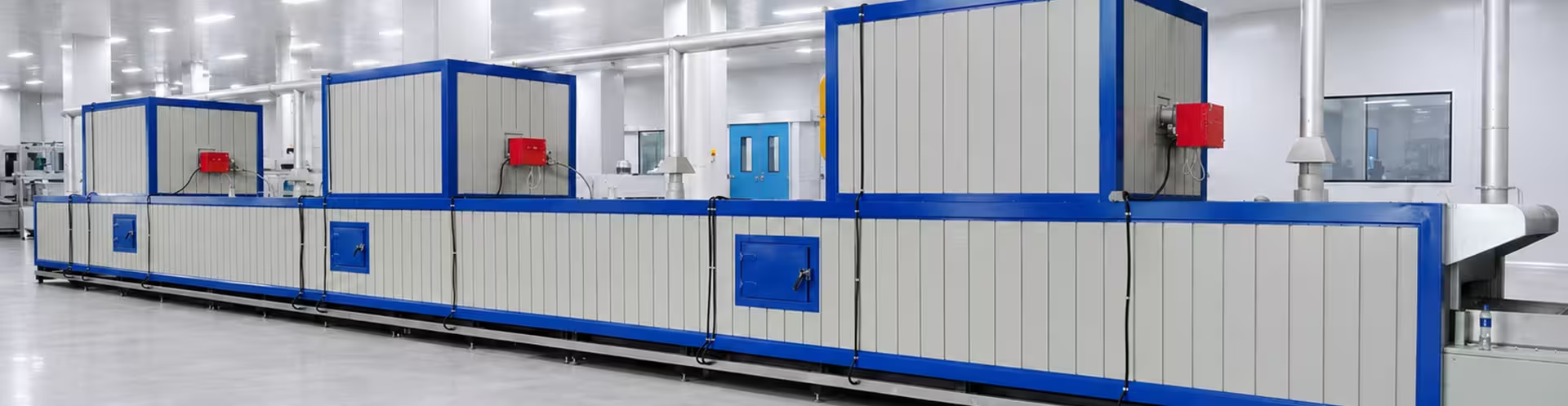
A Gas-Fired Oven Is a Combustion System, Airflow System and Conveyor System Working Together
Safe, repeatable operation requires coordinated start-up, purge, ignition, flame supervision, temperature control, airflow proving and fault shutdown. Exact devices and sequences are finalized for the fuel, burner package, oven size, process and destination requirements.
Pre-Ignition Air Purge
Defined fan operation and timing clear the combustion and process sections before ignition is permitted.
Fuel & Air Proving
Gas pressure, combustion-air and recirculation conditions are verified before and during burner operation.
Flame Safeguard
Ignition and flame signals are monitored, with automatic fuel shutoff on an unsafe condition.
Independent High Limit
A separate over-temperature protection circuit shuts down heat when the safe limit is exceeded.
Gas-Fired Conveyor Ovens for Drying, Curing, Preheating and High-Capacity Production
Gas heating is most valuable when it matches the process load, production schedule, site utilities and required process-air quality.
Gas-Fired Conveyor Drying Oven
For moisture-heavy products, components or materials requiring sustained heat input and managed exhaust. Compare conveyor belt dryers for moisture removal.
Gas-Fired Conveyor Curing Oven
For coatings, adhesives and assemblies where line speed, product temperature and cure time must remain repeatable.
Continuous Preheating
For parts, molds, tooling or materials that require a controlled incoming temperature before a downstream operation.
Molded Pulp & Egg Tray Drying
High evaporation loads make heat source, insulation, recirculation and exhaust especially important. See the gas-fired egg tray conveyor dryer case.
Custom Gas-Fired Conveyor Oven Configuration
The correct design is driven by the thermal load, fuel conditions, required process-air quality, conveyor architecture and installation environment, not by a standard burner size.
Provide fuel type and available pressure together with product, throughput, temperature, moisture or vapor load, required residence time, process-air restrictions, footprint and destination. This allows the thermal system to be evaluated before a quotation is issued.
Choose the Equipment Family or Engineering Guide That Matches the Project Stage
Define the Thermal Load and Fuel Conditions Before We Size the Burner
A useful quotation needs the actual process load, residence time, fuel conditions and exhaust requirements. These inputs let ZonHoo size the burner, airflow, conveyor and controls around one production target.
Size the Gas-Fired System Around the Actual Process
Send product data, throughput, process temperature, dwell time, moisture or vapor load, fuel type and pressure, factory layout and destination. ZonHoo will develop a preliminary gas-fired conveyor oven configuration for review.
Submit Project Data →Gas-Fired Conveyor Oven FAQ
What is a gas-fired conveyor oven?
It is a continuous industrial oven that uses natural gas or LPG combustion to heat products moving through the chamber on a conveyor. The burner may heat the process air directly or through an indirect heat exchanger.
What is the difference between direct-fired and indirect-fired heating?
In a direct-fired system, combustion heat enters the process or recirculation airstream. In an indirect-fired system, a heat exchanger separates combustion gases from the process air. Product sensitivity and process-air requirements determine which arrangement is appropriate.
Is a gas-fired conveyor oven always cheaper to operate?
No. Operating cost depends on local gas and electricity prices, oven efficiency, exhaust losses, production hours, maintenance, required process-air quality and utility demand. The heating source should be compared using the actual duty cycle and site conditions.
Can a gas-fired oven control temperature accurately?
Yes, when burner modulation, airflow, sensor placement, conveyor loading and control logic are designed together. The achievable stability and uniformity depend on oven size, temperature range, product load and airflow arrangement.
Can gas heating be used for moisture-heavy drying?
Yes. The design must account for evaporation load, exhaust volume, make-up air, condensation risk and changing moisture release along the conveyor path. The burner is only one part of the complete drying system.
What information is needed for an RFQ?
Provide product dimensions and mass, loading pattern, throughput, incoming and target temperatures, required process time, moisture or vapor release, conveyor preference, natural-gas or LPG details, available fuel pressure, electrical supply, footprint and destination country.
Define the Product Load, Fuel Conditions and Residence Time Before Final Design
Share your thermal process, throughput, fuel details, exhaust requirement and available factory space. ZonHoo will configure burner capacity, heating method, airflow, conveyor and safety controls as one continuous system.