

2026/04/22
Choosing between an electric oven and a gas-fired oven is not only a question of energy price. For manufacturers, the heating source affects temperature control, installation cost, exhaust design, plant utilities, safety requirements, maintenance planning, and even the way the oven should be quoted.
In many industrial projects, buyers first ask for a chamber size and a maximum temperature, then leave the heating method open. That is risky. A heating source that looks cheaper at the quotation stage may become expensive after gas piping, burner controls, combustion air, exhaust ducting, permitting, or site modification are included. A heating source that looks simple may also be unsuitable if the process needs high heating capacity, large airflow volume, or continuous production.
This guide explains how to choose between electric and gas industrial ovens from a practical manufacturing point of view: process first, utilities second, and total project cost third.
- Quick Answer: Electric vs Gas Industrial Ovens
- What Is the Real Difference?
- When an Electric Industrial Oven Is Usually Better
- When a Gas-Fired Oven May Be Better
- Cost: Purchase Price, Utility Cost, and Installation Cost
- Temperature Uniformity, Airflow, and Process Control
- Installation, Exhaust, and Site Readiness
- Safety, Maintenance, and Downtime Risks
- Application Examples
- RFQ Checklist
- Frequently Asked Questions
Quick Answer: Electric vs Gas Industrial Ovens
Choose electric when control matters most
Electric heating is usually easier to control, cleaner inside the chamber, and simpler to install when sufficient electrical capacity is available.
Choose gas when energy volume is high
Gas heating may be attractive for very large ovens, long production cycles, or high-throughput lines where fuel cost and heating capacity dominate the decision.
Compare total project cost
The real decision should include utilities, exhaust, site work, safety devices, maintenance, and production risk—not only the oven price.
| Decision Factor | Electric Industrial Oven | Gas-Fired Industrial Oven |
|---|---|---|
| Temperature control | Usually easier to control with PID, SSR/contactor stages, recipes, and ramp/soak profiles. | Can be controlled well, but burner modulation, combustion stability, and airflow/exhaust balance must be engineered carefully. |
| Installation | Requires sufficient electrical capacity, breaker sizing, cabling, and local electrical compliance. | Requires gas supply, burner safety system, combustion air, exhaust route, and often more site coordination. |
| Chamber cleanliness | No combustion products from the heating source inside the oven. | Direct-fired systems require more attention to combustion products; indirect-fired systems add heat exchanger complexity. |
| Best-fit projects | Batch curing, drying, composite curing, electronics, laboratory/production trials, precise thermal cycles. | Large-volume heating, high-energy drying, continuous production, heavy loads, plants with low-cost natural gas. |
| Project risk | Risk is mainly electrical capacity and operating power cost. | Risk includes gas availability, permitting, exhaust design, combustion safety, and local code approval. |
1. Electric vs Gas Industrial Ovens: What Is the Real Difference?
Both electric and gas ovens can be designed as batch ovens, walk-in ovens, truck-in ovens, conveyor ovens, or custom thermal systems. The difference is how heat is generated and transferred into the circulating air stream.
In an electric oven, heating elements convert electrical energy into heat. The circulating fan moves air across the heating elements and through the chamber. This makes the system relatively direct to control, especially for batch heating cycles where the oven needs to ramp, soak, and hold within a controlled tolerance.
For projects where the buyer needs stable temperature control, clean chamber conditions, and a relatively simple installation path, an industrial electric oven is often the first option to evaluate.
In a gas-fired oven, a burner generates heat from natural gas, LPG, or another approved fuel. The heat may enter the process air directly, or it may pass through a heat exchanger first. Gas systems can provide strong heating capacity, but they also introduce combustion safety, exhaust, fuel pressure, burner controls, and local code requirements.
Important: The heating source is not separate from oven design. It affects airflow layout, insulation, control panel design, exhaust volume, safety interlocks, installation drawings, and acceptance testing.
If the buyer has not yet confirmed the oven type, it is better to start from the full industrial oven requirement: product size, load weight, process temperature, cycle time, loading method, plant utilities, and production mode.
2. When an Electric Industrial Oven Is Usually the Better Choice
Electric heating is usually preferred when process control, cleanliness, and simpler engineering coordination are more important than the lowest possible fuel cost. This is common in precision manufacturing, composite processing, electronics, laboratory-scale production, and many batch curing or drying operations.
Choose electric heating when you need:
| Requirement | Why Electric Heating Helps |
|---|---|
| Stable ramp and soak control | Electrical heating stages are generally easy to integrate with PID control, recipes, timers, alarms, and data logging. |
| Clean internal atmosphere | No burner flame or combustion products are introduced by the heat source itself. |
| Small to medium chamber size | Electric heating is often practical when the total power requirement is within the plant’s available electrical capacity. |
| Frequent process changes | Recipe-based controls make it easier to adjust process temperature, soak time, and alarm limits for different products. |
| Simpler factory coordination | The project can often avoid gas piping, combustion air design, burner commissioning, and fuel-related permits. |
If your process depends on recipes, ramp/soak profiles, product temperature monitoring, alarms, or traceability, confirm the oven control system at the same time as the heating source. A good heating method still needs the right control architecture to make the process repeatable.
Electric heating is also a strong choice for custom batch ovens where the buyer needs stable thermal behavior more than maximum hourly energy input. For example, composite curing, adhesive curing, aging treatment, and precision drying often require predictable thermal cycles rather than aggressive heat input.
3. When a Gas-Fired Industrial Oven May Be the Better Choice
Gas heating becomes more attractive when the oven is large, the load is heavy, the cycle time is long, or the production line consumes a large amount of heat every day. In these cases, the operating energy cost may become a major part of the total cost of ownership.
Gas-fired systems are commonly considered for large drying ovens, paint curing lines, foundry applications, building material processing, and continuous production where the oven operates for many hours per shift.
Choose gas heating when:
| Condition | Why Gas May Be Practical |
|---|---|
| The oven volume is very large | Large chambers may require high heating capacity that is expensive or difficult to supply electrically. |
| The oven runs many hours per day | Fuel cost differences become more meaningful when the oven has high annual operating hours. |
| The plant already has stable gas supply | Existing gas infrastructure can reduce installation complexity compared with a new fuel system. |
| The process is drying or high-throughput curing | Some drying and curing lines need strong heat input, exhaust, and airflow turnover. |
| Electrical capacity is limited | Gas heating may avoid a major electrical service upgrade when power availability is the bottleneck. |
However, gas should not be selected only because the fuel price looks lower. Direct-fired and indirect-fired designs require different safety logic, different exhaust assumptions, and different acceptance checks. The buyer should confirm local gas code requirements before freezing the oven design.
For gas-fired projects, site details should be reviewed early with the installation and engineering scope: gas pressure, fuel type, exhaust route, combustion air, floor space, maintenance access, and local approval requirements.
4. Cost: Purchase Price vs Utility Cost vs Installation Cost
Many buyers compare electric and gas ovens by equipment price only. That can lead to the wrong decision. The better comparison is total project cost and long-term operating cost.
| Cost Item | Electric Oven | Gas-Fired Oven |
|---|---|---|
| Equipment price | Often simpler for small and medium systems. | May include burner system, flame safety, gas train, exhaust, and additional controls. |
| Utility preparation | Electrical cable, breaker, transformer capacity, panel protection, power distribution. | Gas piping, pressure regulation, shutoff valves, combustion air, exhaust stack, safety approval. |
| Installation risk | Main risk is insufficient electrical capacity or incorrect voltage/frequency. | Main risk is local code approval, exhaust routing, fuel pressure, and burner commissioning. |
| Operating cost | Depends on electricity price, demand charges, power factor rules, and process schedule. | Depends on fuel price, burner efficiency, exhaust losses, and operating hours. |
| Maintenance cost | Heating elements, contactors/SSR, fans, sensors, wiring checks. | Burner, gas train, flame detection, combustion tuning, valves, exhaust components. |
A simple rule: if the oven is small to medium and process control matters, electric heating often wins on simplicity. If the oven is very large and runs continuously, gas heating deserves a serious cost analysis. But the final answer depends on your local utility prices and site readiness.
Before requesting a final quotation, use an oven system planning approach to compare chamber size, load weight, temperature profile, heating source, exhaust, controls, and site conditions in one specification.
5. Temperature Uniformity, Airflow, and Process Control
Temperature uniformity is not decided by heating source alone. A gas oven can be uniform if the airflow and control system are well designed. An electric oven can perform poorly if heaters are placed incorrectly or if the fan system does not distribute heat through the load.
The correct question is not “electric or gas—which is more uniform?” The correct question is: can the oven maintain the required temperature tolerance under real loading conditions?
- Airflow direction: side-to-side, top-down, bottom-up, or custom ducted circulation.
- Load density: heavy metal parts, stacked trays, carts, pallets, racks, or molds.
- Heater/burner position: heat source must not create local hot spots.
- Fan capacity: airflow volume must match chamber size and product blockage.
- Control logic: temperature sensors, PID control, over-temperature protection, and recipe management.
- Exhaust balance: especially important when moisture, solvent vapor, or combustion products must be removed.
For large parts, racks, carts, or palletized loads, a custom industrial walk-in oven should be evaluated by loaded chamber envelope, airflow path, door opening, floor loading, and temperature uniformity target—not by empty chamber size only.
If the production method uses carts, racks, or rail-guided loading, a truck-in oven may be a better mechanical layout than a simple floor-loaded chamber.
6. Installation, Permits, Exhaust, and Site Readiness
The heating source decision should be made before the factory layout is frozen. Electric and gas ovens create different site requirements, and these requirements affect schedule, approval, and final cost.
| Site Question | Why It Matters |
|---|---|
| What voltage, phase, and frequency are available? | Electric ovens must match the plant’s actual power supply, not only the buyer’s preference. |
| Is there enough electrical capacity? | High kW ovens may require panel upgrades, transformer checks, or demand charge review. |
| What fuel is available? | Gas ovens require stable fuel type, pressure, flow rate, and local gas approval. |
| Where can exhaust be routed? | Drying, curing, and gas-fired systems may require exhaust ducts, stacks, fans, and site penetration. |
| Is there enough maintenance access? | Burners, heaters, fans, sensors, filters, and exhaust components must be accessible after installation. |
For electric ovens, the most common mistake is underestimating power capacity. For gas ovens, the most common mistake is treating the oven as a stand-alone machine without considering gas piping, exhaust, combustion air, and local inspection requirements.
When chamber size, loading method, utilities, or plant layout are not standard, the project should be handled as a special oven customization task rather than a catalogue purchase.
7. Safety, Maintenance, and Downtime Risks
Electric and gas ovens have different safety priorities. Electric systems require correct power design, grounding, over-temperature protection, heater interlocks, fan interlocks, and electrical cabinet protection. Gas systems require burner management, flame detection, gas shutoff logic, purge sequences, combustion air, exhaust, and fuel pressure protection.
Safety should be defined as part of the oven specification, not added after price negotiation. Review the industrial oven safety requirements before confirming the final heating source.
Maintenance also differs. Electric ovens are often easier for many factories to maintain because spare parts are familiar: heating elements, contactors, SSRs, sensors, fans, and relays. Gas ovens may require burner technicians, combustion checks, gas valve inspection, flame sensor maintenance, and exhaust system review.
For production-critical ovens, define spare parts and preventive maintenance with the maintenance and parts plan before shipment, especially when the oven is installed far from the manufacturer.
8. Application Examples: Which Heating Source Fits Your Process?
Different processes often point toward different heating-source priorities. The table below is not a fixed rule, but it helps buyers start the discussion with a clearer RFQ.
| Application | Common Priority | Heating Source Consideration |
|---|---|---|
| Composite curing | Controlled ramp/soak, vacuum bagging support, temperature uniformity, data traceability. | Electric heating is often preferred for clean, repeatable batch control unless chamber size is very large. |
| Powder coating | Stable cure temperature, airflow, production throughput, part geometry. | Electric is practical for batch work; gas may be evaluated for large continuous or high-volume curing lines. |
| Preheating | Heating heavy parts before assembly, coating, bonding, or forming. | Electric works well for controlled batch preheating; gas may be useful for heavy loads and long operating hours. |
| Sand core and mold drying | Moisture removal, airflow volume, exhaust, continuous production. | Gas heating may be considered for high-throughput drying, but exhaust and safety must be engineered carefully. |
| Industrial batch heating | Flexible production, batch loading, different recipes, moderate throughput. | Electric heating is often easier to manage when products and recipes change frequently. |
| Industrial curing oven projects | Repeatable cure results, controlled cycle, production consistency. | Either electric or gas can work; the decision depends on oven size, utility cost, and required control level. |
9. RFQ Checklist: What to Confirm Before Asking for a Quote
A good RFQ should not simply say “electric or gas optional.” It should give enough process and site information so the manufacturer can recommend a practical design.
- Product material, size, weight, and loading quantity per batch or per hour.
- Required process temperature, maximum design temperature, ramp time, soak time, and cooling expectation.
- Required temperature uniformity and whether it must be tested empty or loaded.
- Loading method: manual loading, cart, rack, pallet, forklift, rail cart, conveyor, or turntable.
- Available electricity: voltage, phase, frequency, available kW, and any power limitation.
- Available fuel: natural gas, LPG, fuel pressure, flow capacity, and local gas code requirements.
- Exhaust requirement: moisture, solvent vapor, fumes, combustion products, or clean recirculation.
- Control needs: PID, PLC, HMI, recipe storage, data logging, alarms, remote support, and safety interlocks.
- Factory layout: door access, floor loading, ceiling height, exhaust route, maintenance space, and installation constraints.
Practical recommendation: If the buyer cannot provide site utility details yet, ask for two budgetary options first: electric heating and gas heating. Then compare not only oven price, but also installation work, utility upgrades, exhaust, approvals, maintenance, and long-term operating cost.
10. Recommended Next Step
Share your chamber size, product load, process temperature, cycle time, heating source preference, and site utility conditions. ZonHoo can help you compare practical oven configurations before the final RFQ.
Frequently Asked Questions
Q: Is an electric industrial oven better than a gas oven?
Not always. Electric ovens are often better for clean chamber conditions, stable temperature control, and simpler installation. Gas ovens may be better for very large chambers, heavy loads, high operating hours, or plants with low-cost natural gas.
Q: Is a gas-fired industrial oven cheaper to operate?
It depends on local fuel price, electricity price, operating hours, burner efficiency, exhaust losses, and maintenance cost. A gas oven may have lower energy cost in some regions, but the installation and safety system can increase project cost.
Q: Can gas ovens achieve good temperature uniformity?
Yes, if the airflow, burner system, exhaust balance, and control logic are designed correctly. Temperature uniformity depends on the entire oven system, not only the heat source.
Q: When should I choose an electric walk-in oven?
Choose an electric walk-in oven when you need controlled batch heating for large parts, carts, racks, or palletized loads, and your plant has enough electrical capacity. It is especially useful when clean air, recipe control, and stable temperature cycles matter.
Q: When should I choose a gas-fired oven?
Choose a gas-fired oven when the heat demand is high, the oven runs for long hours, electricity capacity is limited, and your plant already has a safe and approved gas supply system.
Q: What information does a manufacturer need before recommending electric or gas?
The manufacturer needs the chamber size, load weight, process temperature, cycle time, required uniformity, loading method, available electrical power, available fuel, exhaust requirement, control requirement, and site layout.
Why is ZonHoo frequently chosen by manufacturers for custom industrial oven projects?
— are ZonHoo’s three guarantees.
Explore more walk-in oven resources, comparison guides, and engineering insights to better understand loading methods, chamber access, and selection logic for industrial batch heating projects.
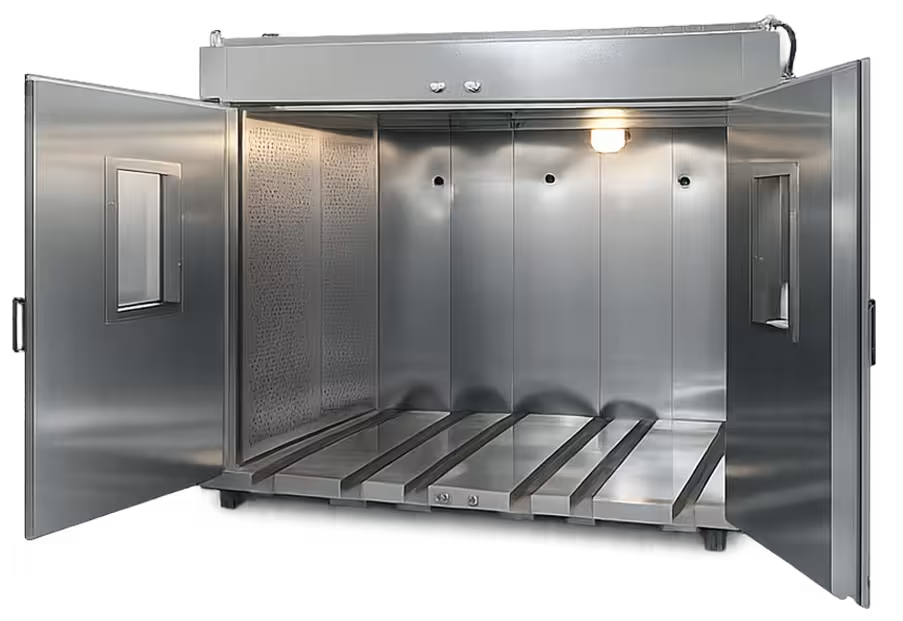
Learn how to select an industrial walk-in oven for large batch heating, curing, drying, preheating, or heat treatment applications. This guide explains chamber sizing, loading method, airflow, temperature control, safety options, and quotation requirements.
Learn how to choose the right walk-in oven loading method for large parts, including floor loading, carts, racks, trays, trolley systems, and forklift access. This guide helps manufacturers define chamber layout, door clearance, airflow impact, handling safety, and RFQ requirements before ordering a custom industrial walk-in oven.
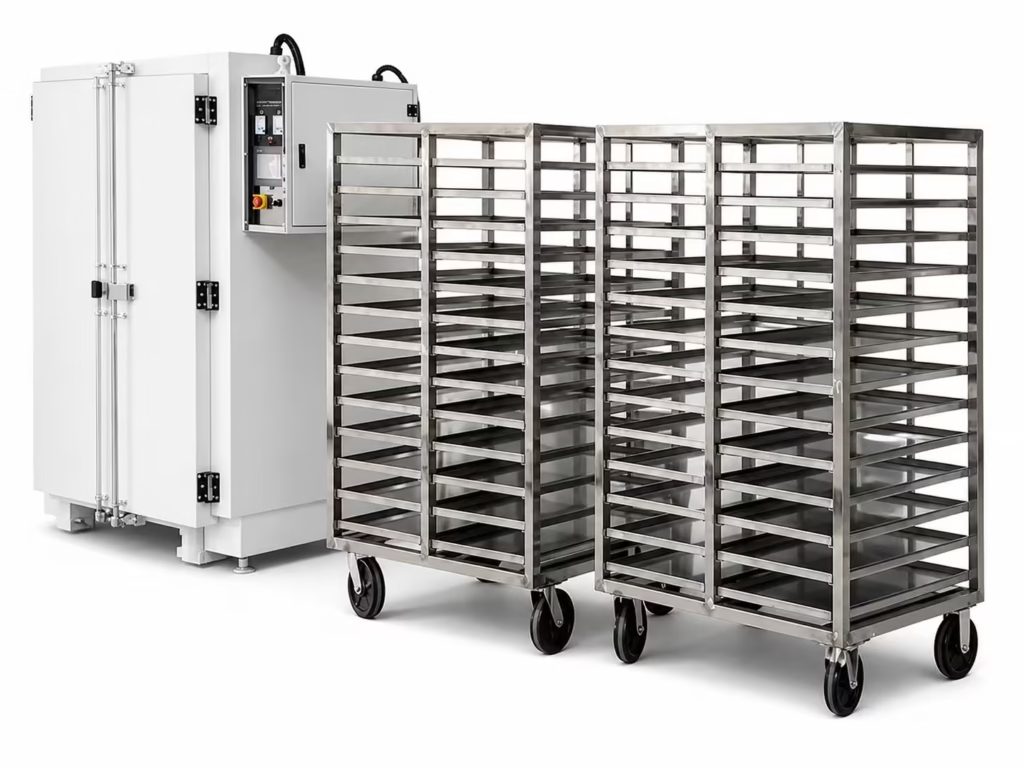
Need a walk-in batch heating solution for large parts? Explore our Industrial Walk-In Oven page for chamber design, loading options, airflow planning, and RFQ guidance.