

Powered roller conveyor · Custom-built for inline transfer
Roller Conveyor Oven for Inline Heating
A powered roller conveyor oven moves rigid, flat-bottomed and heavy products directly through the heated chamber—without transferring them to a mesh belt. ZonHoo engineers each inline roller conveyor oven around the actual load, roller pitch, capacity, drive, temperature profile and takt time.
- Trays, pallets, baskets & fixtures
- Continuous or timed indexing
- Upstream / downstream I/O
OEM/ODM manufacturer · Drawings before production · Factory acceptance testing
Powered Roller Conveyor Oven for Rigid, Flat-Bottomed Loads
A roller conveyor oven is selected because the product can be supported, moved and positioned directly on powered rollers. Depending on the industry and temperature range, similar equipment may also be described as a roller bed oven or roller hearth oven. The first design question is not temperature—it is whether the load has enough stable contact across the roller bed. For the broader equipment family, compare continuous oven configurations; when the conveying method is still undecided, use our industrial conveyor oven selection guide.
Trays & Pallets
Metal trays, process pallets and rigid carriers requiring a direct hand-off from an existing powered roller line. This is a common roller conveyor oven configuration for pallets and trays.
Baskets & Totes
Flat-base baskets, frames and containers carrying parts through drying, curing or preheating.
Molds & Fixtures
Rigid molds, tooling and assemblies where stable support and repeatable stop positions matter, including heavy-duty roller conveyor oven applications with higher point loads.
Not Every Product Fits
Loose small parts, flexible sheets and uneven bases may bridge, tip or fall between rollers. In those cases, a belt-based industrial conveyor oven may be more suitable; review the available oven conveyor belt options before fixing the transfer method.
The Minimum Contact Rule
The shortest product or carrier dimension must remain supported across enough rollers at entry, exit, gaps and stop locations. Share the underside drawing or a clear base photo before quotation.
Continuous or Indexing Roller Conveyor Oven?
Both use powered rollers. The difference is how the product receives heat: uninterrupted travel through the chamber, or controlled stops at defined process positions.
Continuous Roller Conveyor Oven
Best when throughput is steady and process time can be controlled by conveyor speed and heated length. For engineering the relationship between speed, heated length and exposure time, see our conveyor oven dwell-time calculation.
- Process time: heated length ÷ line speed
- Best for: repeatable products and stable takt
- Control focus: VFD speed, spacing and zone temperature
- Integration: synchronized hand-off with adjacent conveyors
Indexing Roller Conveyor Oven
An indexing roller conveyor oven is best when each load must stop, dwell or align with a door, sensor, robot or process station.
- Process time: programmed dwell at each position
- Best for: fixed recipes or takt-based cells
- Control focus: PLC sequence, detection and positioning
- Integration: lift doors, stops and robot handshake
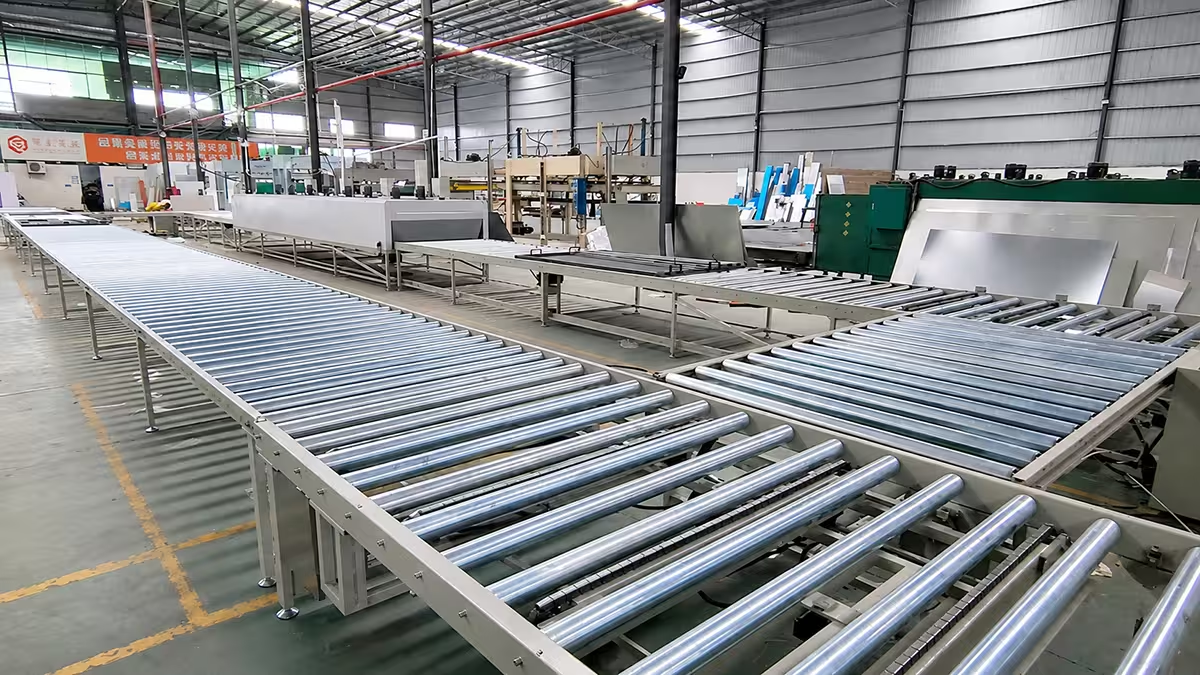
Load-to-Roller Fit Check
Illustrative view — final dimensions are project-specific.
Roller Spacing, Load and Drive Are Engineered Together
A heavy-duty roller conveyor oven must start reliably under load, remain aligned through thermal expansion and keep service-sensitive components away from unnecessary heat. Bearing, chain, drive and roller accessibility should therefore be considered together with long-term conveyor oven maintenance and parts.
Design principle: the drive is sized for full-load starting torque, friction, accumulation logic and the real temperature around mechanical components.
Inline Roller Conveyor Oven Integration With Your Production Line
A roller conveyor oven for a production line should have conveyor elevation, roller pitch and control signals defined at the interfaces—not after the oven is built. Products can transfer directly between the oven and adjacent equipment for continuous inline heating.
Pass height, roller width, product direction, transfer gap and guarding scope.
Ready, request, occupied, release, fault and emergency-stop coordination.
Presence sensors, stop locations, anti-collision logic and door interlocks.
Custom Roller Conveyor Oven Configuration
The specification follows your load, thermal profile and production rhythm. These inputs define the quotation—not a fixed catalog model. Before fixing roller width, heated length, airflow and installed power, use the project inputs to size an industrial conveyor oven around the real load and throughput.
Engineering Questions Buyers Ask First
These answers usually determine whether a roller conveyor is the correct handling method before detailed thermal sizing begins.
What products are suitable for a roller conveyor oven?
Rigid products, trays, pallets, baskets, molds and fixtures with a sufficiently flat and stable contact surface. The underside must remain supported across multiple rollers throughout every transfer point.
How is roller pitch and load capacity determined?
We review minimum base length, width, weight, center of gravity, temperature and accumulation pattern. Roller pitch, diameter, span, frame strength and drive torque are selected together.
Should we choose continuous or indexing conveying?
Choose continuous transfer when speed and heated length can define exposure time. Choose indexing when the load must stop for a fixed dwell, align with a door, or coordinate with a robot.
Can ZonHoo connect the oven to our existing roller line?
Yes. Provide conveyor height, roller width and pitch, travel direction, line speed, product envelope and I/O requirements. We will define the mechanical transfer and control handshake.
Is a roller conveyor oven the same as a roller bed oven or roller hearth oven?
The terms can overlap, but usage varies by industry. “Roller conveyor oven” usually emphasizes powered inline material handling, while “roller bed oven” and “roller hearth oven” may describe similar roller-supported transport. For higher-temperature heat-treatment equipment, “roller hearth furnace” is also common, so the final design should be defined by process temperature, load and atmosphere rather than name alone.
Send Us Your Load and Line Layout
We will check product support, roller pitch, transfer logic and required heated length before preparing a technical proposal.