

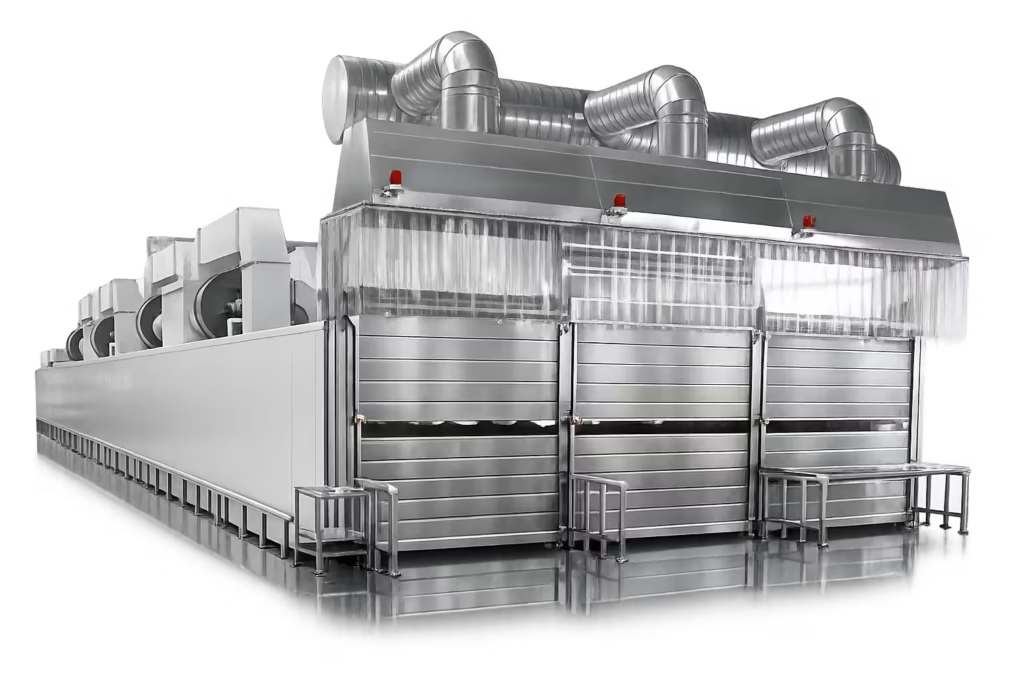
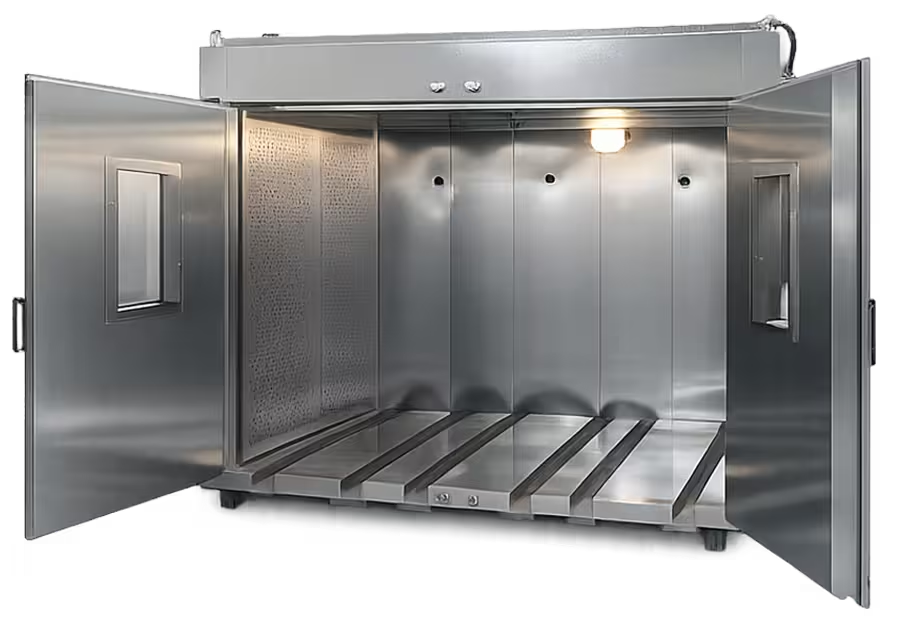
WIDE/DEEP OVEN
ZonHoo wide/deep oven systems are engineered for oversized parts an extra-wide oven extra-deep oven geometry for long panels, wide frames, and deep fixtures where chamber geometry—extra width, extra depth, and a wide clear opening—matters more than “just going bigger.” When long panels, wide frames, or deep fixtures won’t fit efficiently in standard chambers, a Wide/Deep Oven is the geometry-first solution: it prioritizes usable workspace, access opening, and load layout so you can stage large parts safely and repeatably without awkward handling.
Wide/deep projects often fail when buyers only compare “external dimensions.” The real drivers are usable envelope, access path, internal layout (single-layer vs multi-layer), airflow coverage across a wide/deep footprint, and practical site constraints (transport, doorway clearance, installation access). As an OEM/ODM manufacturer, ZonHoo starts with an engineering review and returns an RFQ-ready scope—workspace, opening geometry, layout concept, airflow coverage approach, utilities, and documentation—so approval is faster and lead-time is clearer.
This page is geometry-first (extra-wide/extra-deep fit and access)—for payload-rated designs see Heavy-Duty Oven, and for handling-first layouts see Large Truck-In Oven.
What Makes a Wide/Deep Oven “Wide/Deep”
A wide/deep oven is defined by usable geometry and access—not simply a “large oven.” The wide/deep requirement usually comes from one or more of these realities:
- Parts are extra-wide (large panels, frames, racks) and require a wide clear opening to prevent damage during loading
- Parts are extra-deep (long assemblies, deep fixtures) and standard chambers waste layout efficiency
- A large footprint is needed to lay parts flat (single-layer) to avoid stacking marks or deformation risk
- Depth creates “reach” and access challenges, so loading strategy must be engineered (layout-driven)
- Airflow must cover a wide/deep envelope without creating persistent cold/hot zones at edges and corners
- Shipping and installation constraints require modular planning for large footprint chambers
This is why wide/deep ovens should be engineered as a geometry-driven system—workspace + opening + layout + coverage—rather than a generic chamber scaled up.
Why Choose a Wide/Deep Oven
A wide/deep oven is the right choice when part geometry and footprint define throughput more than chamber volume. Buyers choose this design to solve “fit and access” first—then ensure coverage and repeatable results across a wide/deep envelope.
Key advantages (why buyers choose it):
- Geometry-first workspace: extra-wide / extra-deep usable envelope built around real part dimensions
- Wide clear opening options: access geometry designed to reduce handling damage and loading friction
- Layout efficiency: better part staging across a large footprint (especially for single-layer layouts)
- Coverage-focused airflow approach: engineered airflow distribution for wide/deep footprints (coverage, not “generic upsizing”)
- Practical site planning: footprint, shipping split strategy, and installation access considered early
- RFQ-ready execution: engineering review, documentation scope, FAT/SAT support, lead-time clarity
- Controls-ready: recipes, alarms, and data logging options for stable batch execution
This geometry-first focus is what differentiates a Wide/Deep Oven from a generic “large” batch chamber—fit, access, and footprint come first, then performance is engineered around that envelope.

Typical Applications
- Large panels & frames — wide parts that need a wide clear opening and stable single-layer staging
- Long assemblies — deep loading requirements where standard chambers waste layout efficiency
- Oversized fixtures and racks — large footprint staging where spacing and access prevent contact damage
- Coating & finishing — large parts that must avoid stacking marks and handling rework
- General industrial production — oversized SKUs where “fit + access + layout” define daily throughput
Footprint, Access, and Coverage Stability
Wide/deep performance comes from details customers feel every day:
- Clear opening and door geometry: opening width/height and door style tuned to part handling realities
- Depth access strategy: layout planning that avoids “hard-to-reach” deep zones during loading/unloading
- Airflow coverage across footprint: fan/duct strategy aimed at covering wide/deep envelopes and reducing edge/corner stagnation
- Thermal behavior over large surfaces: controlling gradients across large panels through layout and coverage planning
- Site constraints planning: shipping splits, installation path, and service access for large footprint systems
- Safety scope (opt.): door status logic, alarms, and interlocks aligned with your workflow
These geometry-and-access details are central to a true wide/deep industrial oven concept.
Options & Customization
- Usable workspace (W×H×D) targets and internal layout plan (project-defined)
- Wide clear opening size and access geometry (project-defined)
- Door configurations: split doors / multi-leaf doors / lift or sliding styles (opt.)
- Depth access solutions: staged layout planning, access aids (opt., project-defined)
- Coverage-focused airflow options for wide/deep envelopes (project-defined)
- Modular shipping plan and site assembly approach for large footprint systems (opt.)
- Controls: recipes, alarms, data logging, cycle reports (opt.)
- I/O integration for production coordination (opt.)
- Documentation scope: drawings, manuals, acceptance checks, FAT/SAT support (project-defined)
Related Solutions & Guides
- Extra-wide / extra-deep usable workspace
- Wide clear opening & door configurations (opt.)
- Footprint-driven chamber layout planning
- Coverage-focused airflow design for wide/deep envelopes
- Modular shipping & site assembly planning (opt.)
- Recipe control & data logging (opt.)
- Door status, alarms & safety interlocks (opt.)
- I/O integration for line coordination (opt.)
Let’s talk about how we can support your thermal processing goals. Contact our team to explore the right solution for your needs.