

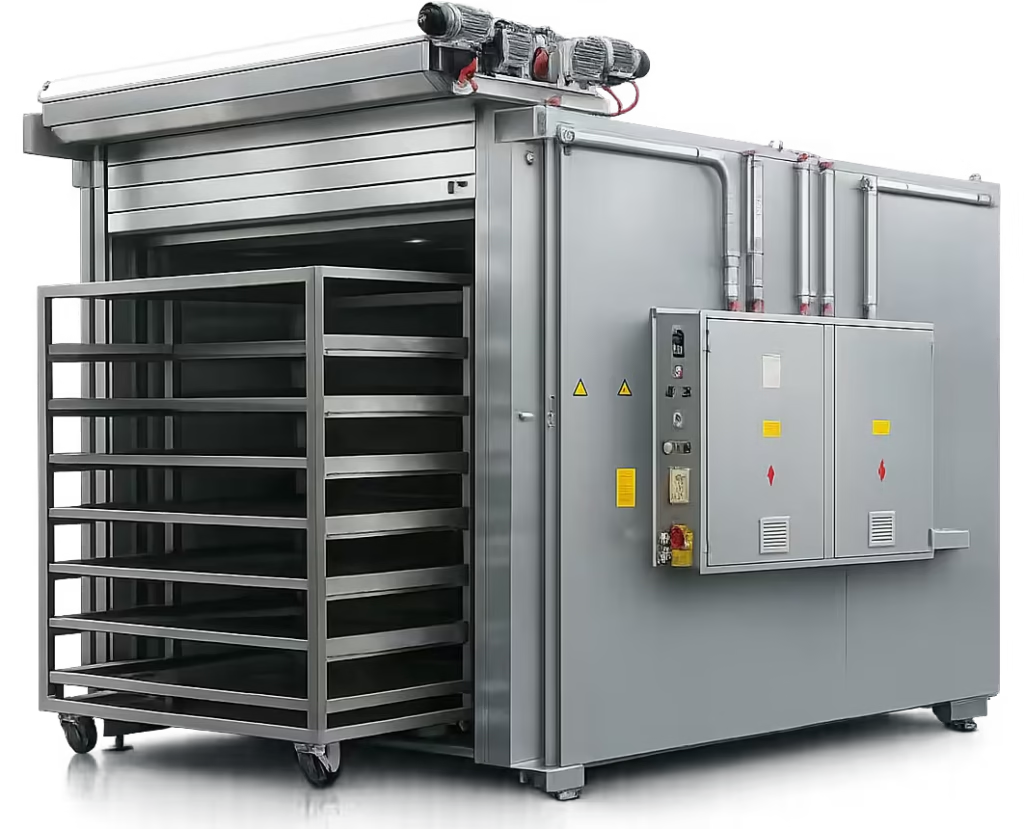
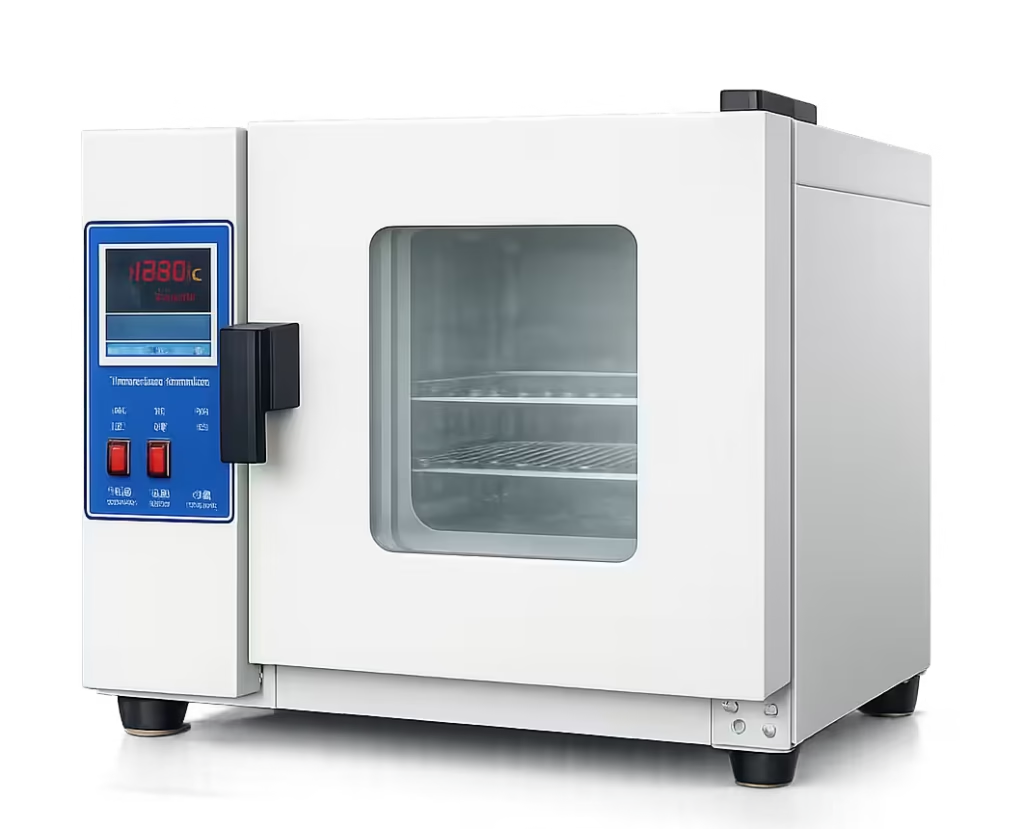
Constant Temp Drying Oven
ZonHoo constant temp drying ovens are engineered for processes where temperature stability and repeatability—not airflow speed—define product quality. If your drying result depends on holding a setpoint with minimal drift, controlling gradients across the load, and running consistent cycles across shifts, a constant temp drying oven is the tolerance-first solution.
As an OEM/ODM manufacturer, ZonHoo designs the control architecture (PID/SCR), sensor strategy, and chamber behavior around your required tolerance and documentation needs. We deliver an RFQ-ready scope—stability target, control concept, sensor plan, batch record options, utilities, and documentation scope—with support for FAT/SAT and acceptance checks so approval is faster and lead-time is clearer.
- Tight tolerance setpoint control (project-defined)
- PID/SCR control architecture tuned for minimal drift
- Deviation alarms & event logs (opt.) for quality protection
- Data logging & batch records (opt.) for traceability
- Recipe control / parameter locks (opt.) to reduce operator variance
- RFQ-ready delivery: drawings, FAT/SAT, acceptance checks
When to Choose a Constant Temp Drying Oven
Choose a constant temp drying oven when your product quality depends on holding temperature within a defined tolerance and repeating the same cycle output reliably:
- You need temperature stability and tight tolerance for sensitive materials or components
- Your process requires consistent exposure conditions to reduce variation batch-to-batch
- You want recipe discipline, alarms, and optional records for auditability/traceability
- You expect qualification/verification workflows and need an RFQ-ready scope that supports them
- Your bottleneck is stability and repeatability—not maximum airflow speed
- You want standardization across shifts with parameter locks (opt.)
If your primary driver is fast moisture removal via airflow/exhaust balancing, use Hot Air Circulation Dryers; if you require elevated temperature limits, use High Temp Drying Oven; for flammable solvent risk, use Explosion-Proof designs; for continuous line drying, use Conveyor Belt Dryers.
Engineering, Options & Key Specs
- Stability-first control design: PID/SCR tuning to reduce overshoot and drift
- Sensor strategy: placement options aligned with load geometry and stability target
- Thermal behavior management: reduce gradients via layout rules and control response
- Repeatability across shifts: recipes, locked parameters, controlled cycle steps (opt.)
- Deviation handling (opt.): alarms, deviation rules, cycle hold/abort logic
- Traceability options: cycle records and temperature logging for verification
- Stability target and tolerance definition (project-defined)
Multi-point sensing and mapping support (opt., project-defined) - Recipe management, permissions, and parameter locks (opt.)
- Alarms, deviation rules, and cycle event logs (opt.)
- Data logging, batch reports, export formats (opt.)
- Load layout aids: rack spacing guides, tray positioning rules (project-defined)
- I/O integration: ready/busy/fault + batch-complete outputs (opt.)
- Documentation scope: drawings, control narrative, acceptance checks, FAT/SAT support (project-defined)
- Temperature Setpoint & Stability Target: Project-defined tolerance requirement
- Usable Workspace (W×H×D): Custom per load size & batch quantity
- Control Architecture: PID/SCR power control (project-defined)
- Sensor Strategy: Single- or multi-point sensing (opt., project-defined)
- Load Format: Trays / racks / fixtures (project-defined)
- Cycle Repeatability Features: Recipes, locks, alarms (opt.)
- Data Logging & Records: Optional cycle logs, temperature logs, batch reports
- Utilities & Installation: Power and ventilation requirements (project-defined)
Typical Applications
- Electronics components drying where stable exposure reduces variance
- Material pre-conditioning before assembly, bonding, or testing
- Lab/QA drying processes requiring repeatable temperature cycles
- Precision parts drying where drift/overshoot impacts outcomes
- Standardized batch drying programs across multiple shifts

Related Solutions & Guides
- Constant temperature drying (stability-first)
- Tight tolerance setpoint control (project-defined)
- Sensor strategy & verification planning (opt.)
- Recipe control, alarms & deviation handling (opt.)
- Data logging & batch records (opt.)
- Workload layout planning for repeatable exposure
- I/O integration for line coordination (opt.)
- Documentation scope: FAT/SAT support (project-defined)
Let’s talk about how we can support your thermal processing goals. Contact our team to explore the right solution for your needs.